DANSE MACABRE AT WORLD CULTURE FESTIVAL
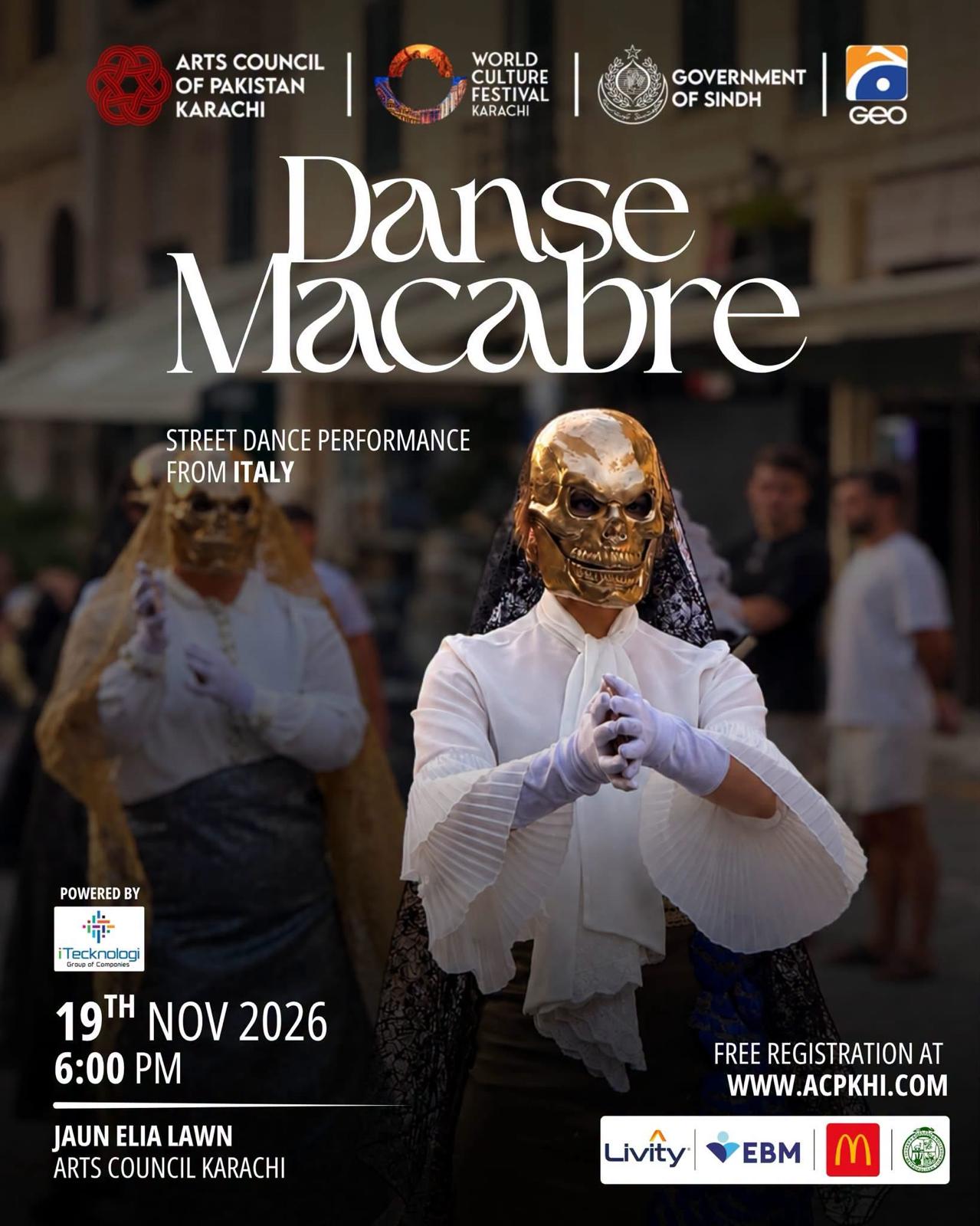

VISUAL ARTIST AND THEATRE DIRECTOR
OPEN CALL | DANSE MACABRE × MALTA BIENNALE 2026

Actors. Performers. Musicians.
Professionals and non-professionals — all welcome.
Italian visual artist Azzurra De Gregorio is inviting you to join a site-specific performance in the iconic Upper Barrakka Gardens, Valletta — as part of Malta Biennale 2026.
Together we’ll reimagine the medieval allegory of death through movement, space, and today’s social realities.
✦ ~7 workshops + on-site rehearsals
✦ Final performance — 28 May 2026, 19:30
✦ Free of charge
✦ Certificate upon request
This is your chance to be part of an international artistic project — no stage too big, no background required.
DEADLINE: 15 APRIL 2026!
Application link open call


Krinzinger Schottenfeld
Face and Mask
Carlos Amorales
 with works by Jeroen Kooijmaans , Azzurra de Gregorio , Chiara Zenzani , Rowena Morales , Víctor del Moral , Astrid Svangren , Eric Tlaseca , Issac Olvera.
Schottenfeldgasse 45, 1070 Vienna
Face and Mask
Carlos Amorales turns the mask into a mirror of our time. It is not merely an ornament or disguise, but a territory where identity, myth, and power intersect.
This new exhibition reveals how what the mask conceals ends up showing with greater force: the fragility of the human in the face of technology, the tension between the local and the global, between the intimate and the collective. Far from conceiving the face or the mask as an aesthetic or ritual accessory, the artist places them at the center of a reflection that questions identity, representation, and the politics of the image in the digital age.
Since ancient times, the mask has served as a mediator between the self and the other, between the human and the divine, between the visible and the hidden. Amorales takes up this symbolic device and inserts it into a field of current tensions, where the face and mask become a space of social recognition and subjectivity confronted with media saturation, technological control, and the precariousness of cultural narratives in globalization.
The dialogue established with the iconic figure of El Santo, the Silver-Masked Man, is fundamental. By recovering this symbol of Mexican identity, Carlos not only refers to a popular icon, but also exposes the fragility of collective identities in the face of global discourse. The wrestling mask, which in its original context protects while simultaneously constructing a myth, here becomes a metaphor for a lost search for identity, an attempt to cling to cultural signs in the face of homogenization.
The critique is enriched by the reference to Roland Barthes: myth as a mask that conceals ideologies. In this sense, Amorales’ work not only plays with visual surface, but also reveals how the images we consume and produce in the digital age reproduce naturalized falsehoods, legitimizing structures of power. The mask, in his proposal, ceases to be a simple object and becomes a mechanism for critical reading of the contemporary.
Taken as a whole, Face and Mask transcends the formalism of portraiture or visual object. His drawings and audiovisuals function as critical essays that invite viewers to rethink not only the function of the mask, but also the nature of identity in a present shaped by screens, algorithms, and globalized narratives. Carlos manages to turn the unsettling quality of the mask—its capacity to simultaneously conceal and reveal—into fertile ground for questioning the tensions between art, technology, and ideology.
In the exhibition Face and Mask, eight artists from different latitudes engage in dialogue with the work of Carlos Amorales, taking the mask as their starting point. From diverse disciplines—installation, performance, visual arts, painting, and sculpture—each proposal turns the mask into a territory of meanings in constant transformation: identity and anonymity, ritual and resistance, concealment and revelation. This collective space not only broadens the reading of Amorales’ work, but also invites the public to discover how the mask, beyond its form, remains a living symbol that connects cultures, memories, and contemporary sensibilities.
The title of this exhibition is inspired by a work of Hans Belting, whose reflections have decisively shaped the contemporary studies on images.
Oscarito Sanchez

We invite you to Prague Quadrennial’s symposium on Technologies in theatre, performance, and exhibition design. Together with almost a hundred speakers from 30 countries across six continents, we will be exploring the multi-dimensional dynamic of technologies in theatre, performance, and exhibition design.
Technologies in theatre, performance, and exhibition design
Whether old or new, high or low, digital or analogue, technologies, or different tools, instruments, devices, equipment, machines, and machinery, are potential and potent resources in the scenographic process. The recent technological developments that require more specialized knowledge and expertise have brought on the need and the opportunity for scenographers and designers to collaborate with scientists, engineers, and industry partners. While pushing the boundaries of what is possible in performance, employing these most advanced technologies is conditioned by access, stemming from material, institutional, and political conditions in which we produce art. Moreover, our ideas of technologies are often reduced to Western notions of progress and innovation.
Together with more than 80 speakers from 30 countries across six continents – performance designers, scenographers, makers, artists, and researchers who work with and on technologies – we will be exploring the multi-dimensional dynamic of technologies in theatre, performance, and exhibition design.

Visual Artist: Azzurra De Gregorio
Libretto: Pier Lorenzo Pisano
Composer: Ljubomir Nicolic
Director: Máté Czakó
Concept: Mate Czako, Ljubomir Nikolic, Pier Lorenzo Pisano
Artists: Francesco Venturi, Bojan Milinkovic, Alice Norma Lombardi, Patryk Tiktak Matela, Azzurra De Gregorio, Mate Czako, Pier Lorenzo Pisano, Ljubomir Nikolic, Thea Soti, Balázs Várnai, Marko Dulic.
-> 12 July, 20:00 – Lepenski Vir, Serbia
-> 14 July, 20:00 – Dorcol Platz, Belgrade
-> 18 July, 18:00 – Museo Sigismondo Castromediano, Lecce
-> 22-23 July, 18.30 – Valley of Arts Festival,Kapolcs, Hungary
FIRST EUROPE PROJECT behind VIR aims to promote and celebrate Europe’s archaeological heritage, with a special focus on the fascinating site of Lepenski Vir in Serbia, which formed one of the oldest settlements in Europe, hence the name of our project: FIRST EUROPE.
Partners of the project:
Y csoport
ECCOM – Idee per la Cultura
Lepenski Vir


WORKSHOP Azzurra De Gregorio
During this participatory project, Azzurra De Gregorio explores the magic and rituals behind faith as well as the role of ex-votos together with the public. Participants make their own ex-votos, with inspiration drawn from different countries and historical periods, and experience new forms of hybrid and shared rituals.
With the support of Erfgoedcel Brugge, CC Brugge and Musea Brugge
PROCESSION Azzurra De Gregorio
P.G.R. is for all visitors to the Reiefestival who would like to thank someone or something for granting their wishes. The ex-votos made during the workshop will be offered to a mysterious figure during a boat procession, who will then perform a ritual on the water.
With the support of Erfgoedcel Brugge, CC Brugge and Musea Brugge


DANSATHON is a 3 days connected, collaborative, European event to imagine the future of dance.
At the crossroads between dance and new technologies to imagine new artistic forms, new stages, new experiences and new ways to engage. Combining the best of these two worlds to imagine the dance of tomorrow, enhance cultural life and social interactions. These are the aim of the DANSATHON project.
Initiated by BNP Paribas Foundation, the Dansathon is co-organised and developed in partnership with three major Dance Institutions :
Mix dance and technology to imagine new forms of art, new stages, new experiences and interactions.Combine the best of two worlds to imagine the future of dance, enrich cultural life and increase social interaction. This is our aspiration with the DANSATHON.
Dance is a language which can create a shared sense of belonging, of endeavour, of experience. The Dansathon proposes to explore how this can be retained while embracing the opportunities of new technologies.
Today, dance exists in theatres, in the city, on the web. Theatres are important actors of the city and play a major role in people’s social and cultural life. In the digital era, they search for new paths to connect with their community and talk to new audience.
Mixing dance and technology, can we create new artistic forms? What kind of performance can we imagine? What kind of new experience? How can we make dance more viral and accessible?
How can digital dance cross boundaries, social, physical, cultural? How can theatres better contribute to a rich and harmonious urban life?
How can we multiply positive collective experience? What would be a digital dancing society?
This 2nd edition, if the global health situation allows, will take place between 19-21 November 2021 in the Média Rives Studios of Radio-Télévision belge francophone.
MACCHINE UMANE
workshop a cura di
AZZURRA DE GREGORIO
Artist network About the Future Festival
ORE 17,00
SPAZIO 1 PALAZZO GIL


